


The good intentions of the new year also concern wines and appellations. They are also set by the local delegation ‘Slow Food of Campi Flegrei’, here represented by mr. Orlacchi, in collaboration with the international net of Slow Wine with a serious analysis of what has been, is and will be for such a fascinating volcanic production area in Southern Italy.
The past is represented by the historic vines and the responsibility of the producers to preserve them. The present reflects the numerous production difficulties and specific to the place as well as general ones of the wine sector that foreshadow a future, unfortunately, complicated.
After the welcome, the journalist Alessandro Marra, vice-curator of Slow Wine thus introduced a tasting path that serves to trace the path taken by this area. This was accompanied by the dutiful and, as usual, passionate intervention of Elena Martusciello who recalled the fundamental steps of Gennaro Martusciello, thanks to which the DOC Campi Flegrei was also recognized in 1994.
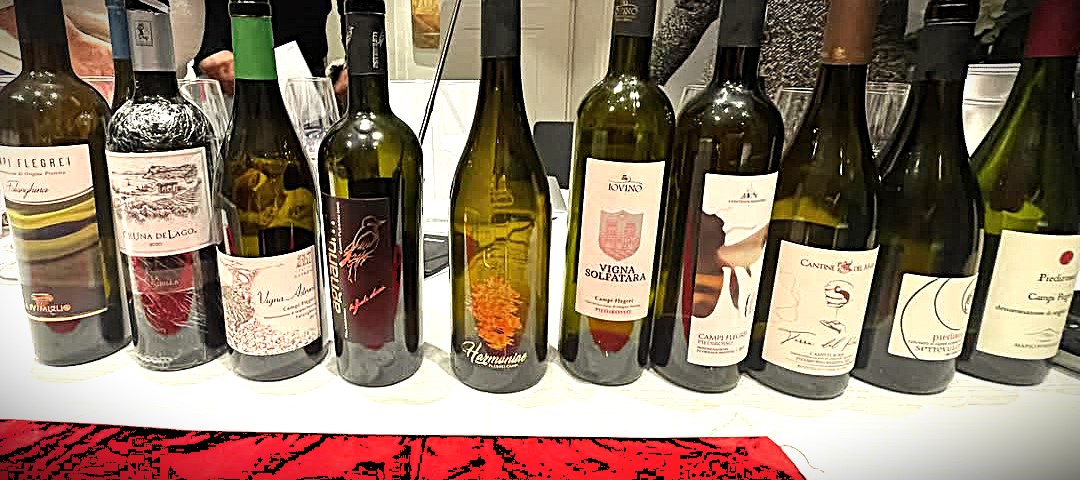
Ten wineries have been involved, each with a different reference from different vintages also for the whites. Falanghina is the wihite variety and Piedirosso the black one and both are the main character of the local appellation (Campi Flegrei DOC) in this volcanic area north of Napoli downtown in Campania region, Southern Italy with a Mediterranean climate and the typical sandy volcanic soils which allows for ungrafted vines and strong personality.
Starting from the whites, the Falanghina dei Campi Flegrei DOC 2021 by IV Miglio is sulphurous, fine and long; the one from La Sibilla (“Cruna del lago” 2020) is precise in the fruity bouquet with a bitter finish, the one from Cantine Astroni is welcoming and sober and appears particularly young despite being a 2019 (“Vigna Astroni”). More developed is that of Agnanum with which we push ourselves to 2017, as well as that of Cantine Babbo Harmoniae of 2016.
Beyond the individual interpretations or evolutions in the bottle, the whites are all aligned on a linearity that recalls the territory with savory precision and propensity for more or less long aging. More varied is the range of reds, the Piedirosso Campi Flegrei DOC, more marked by the vessels such as wood for instance. Despite this, the drinkability, that never betrays the complexity of drinking, remains a trait that makes this red contemporary and potentially very desirable by people as well restaurants and wine bars.
The picture is well reflected by that of Iovino (“Vigna Solfatara” 2021): playful and coherent; meaty but still easy that of Contrada Salandra (2019); more developed but still juicy that of Cantine del Mare (“Terre del Padre” 2018); “dark” in its aromas on the nose and, consistently, austere on the palate the developed version of Martusciello (2017) to then return to the juicy label of the Az. Agricola Mario Portolano (2015).
A clear maturity is represented by the territory as a whole, as demonstrated by the wines and comparison appointments – between producers, press and operators – like these. The usual awareness on site, a push on the accelerator of the communication machine, not always simple reflecting the complexity of certain productions.