

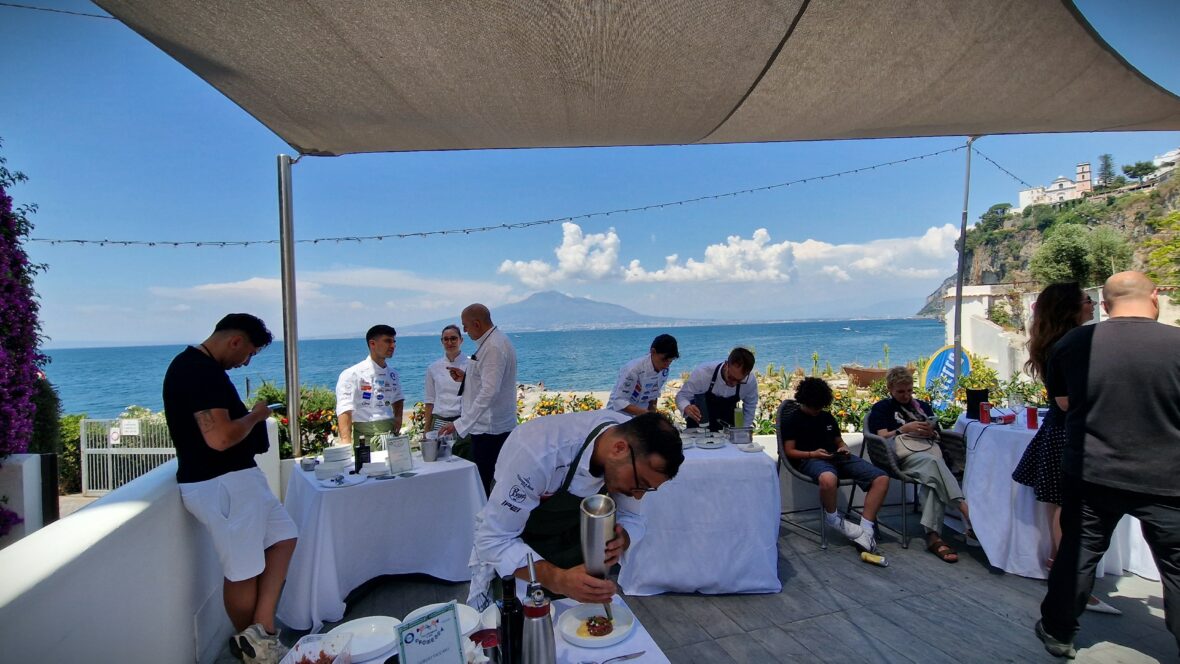

Over the years, “Festa a Vico” (Southern Italy) has become one of the benchmark events in Italian gastronomy. An event capable of capturing the industry’s key themes and emerging trends while continuously evolving without losing its identity. The 2026 edition adopted a leaner format, with a more streamlined programme spread between Vico Equense and Sorrento. Among its many events, however, there is one that, to me, conveys its strongest message.
I am referring to Una promessa è una promessa (A Promise is a Promise), an initiative that Gennaro Esposito has championed for years with an idea that is as simple as it is fundamental: talent should be recognised while it is still a promise, not only once it has already become a success.
It is not a competition, but a message. A message that may seem obvious, yet remains as relevant as ever: identifying and nurturing young talent. Rather than a contest, it offers aspiring chefs the opportunity to present their culinary identity to journalists, established chefs and hospitality professionals, as Gennaro Esposito himself often reminds us.
The diversity of this year’s dishes made that philosophy clear. From Giorgio Vaccaro’s Mediterranean fresella (Partage, Naples)—one of my personal favourites alongside Filippo Chignola’s Tortello in brodo non in brodo (La Casa degli Spiriti, Costermano sul Garda)—to the vegetable-inspired influences of Enrico Fusi and Angelo Barletta, whose smoked peas with green apple, kizami wasabi and fig leaf (FuBa, Tavarnelle Val di Pesa) stood out for their originality. There was no single style that participants were expected to follow, only the encouragement to express a contemporary cuisine with a distinct personal identity. What impressed me most was the recurring reinterpretation of tradition through modern techniques and thoughtful reflection, always aimed at achieving balance while delivering vibrant, expressive flavours.
At a time when gastronomy is undergoing profound change—sometimes drifting towards elitist attitudes and languages increasingly disconnected from diners—an initiative like this brings the focus back to the true essence of cooking: ideas, technique, identity and flavour, before any exercise in style.