


A silent reference that echoes. Clear ideas and solid projects for high-quality production are the basis of Hartmann Donà’s fame (in Alto Adige, Northern Italy). After studying in Geisenheim (Germany), he was the winemaker of Terlan for years until he had the resources launch his own project, for the freedom to go against the criticisms of those who see less far. For instance, in 1986 he invested in a vineyard at 500m in Cornaiano to produce reds. It was the same local office that advised to focus on whites while today all the neighbors work with black grapes in the same area.
Despite this, in the last 8 years, the harvest has been postponed to the end of August and, therefore, one wonders: what will we get to in the future, for example, with Pinot Noir? It is not (only?) the altitude, even when possible, that can solve the climate problem, it is much more complex than that: each variety has a different need, perhaps for Schiava – for now – it is simpler because it is late ripener.
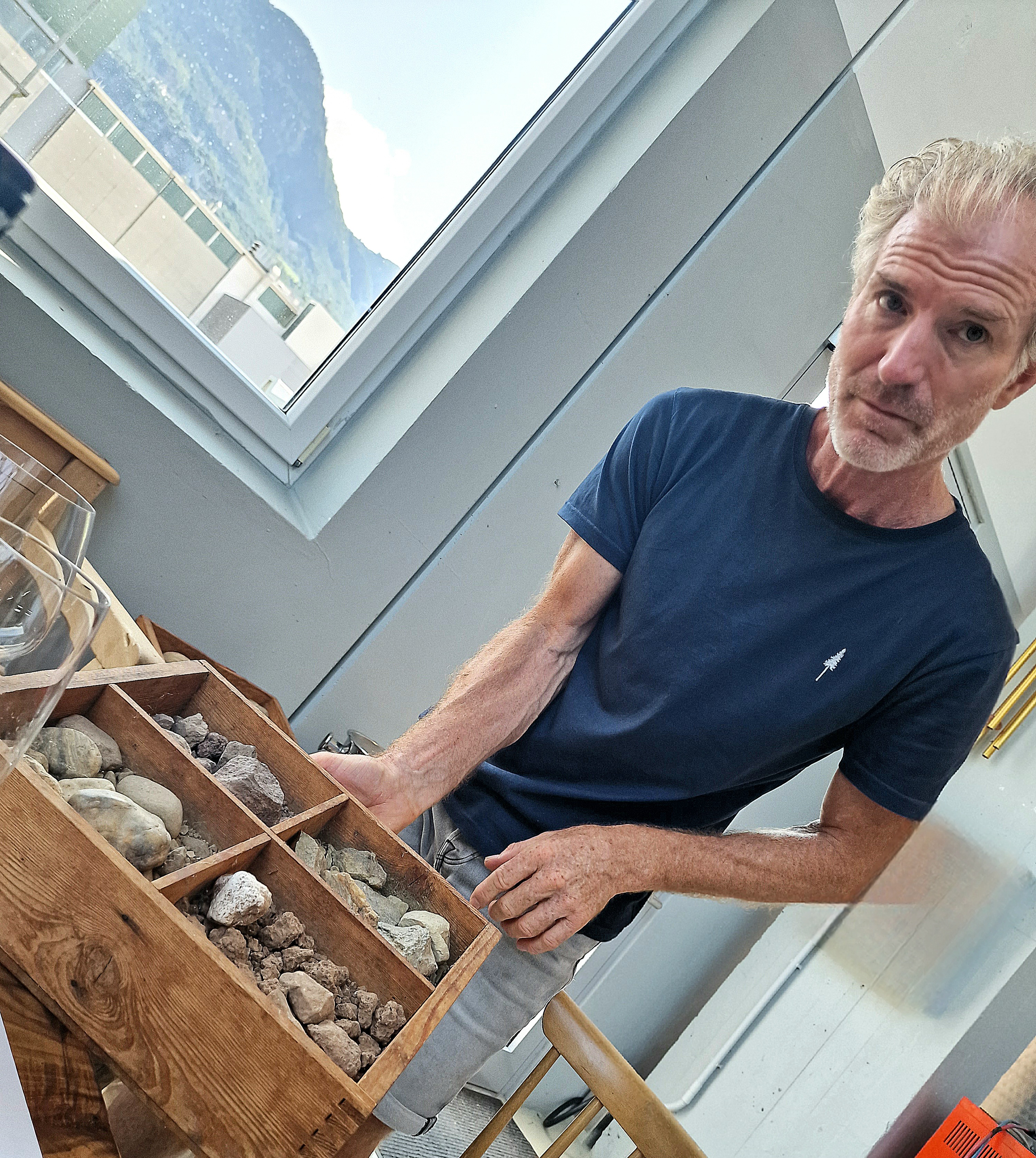
hartmann donà – soils
Since he has been free he feels even more inspired, he admits, and I would say it is evident. Initially he continued to do consultancy all over Italy in order to accumulate further experience and broaden his horizons before developing that idea he had in mind. Today he works with about 14 winemakers from different areas of South Tyrol.
Dwelling on the tasting notes would sound reductive for a producer that appreciated but, fe examplem here is where I drank one of the best Italian Sauvignon Blancs, not surprisingly I believe in it more than Riesling because in these conditions – especially climatic – it offers better balances: the green touch, the grapefruit, the lime with a progression that develops on the palate in a circular direction up to the aftertaste without interruption, a bit like in certain areas of France: a wine that does not expand too much so as not to disappoint the palate.
In short, he produces three lines: the fresh and young one, the reserves (Donà Rouge/Noir/Blanc) and ‘Liquid Stone’ to enhance the beloved (local black grape) Schiava. The Donà Noir (Pinot Noir) and the Donà Rouge (Schiava Riserva, of which I tasted the 2018 with layers of refreshing herbs, flowers and undergrowth for a rounded and long sip) stand alongside the white and the bubble of Schiava (in white, Brut, that today comes from the bunches of old vines with less uniform ripening and/or to thin out: excellent as it is satisfying and fine at the same time).
Actually, he is aware of the dispersion that Alto Adige production entails in terms of communication but territory and tradition lead to the production of this high number of vines and so much diversification at least for the whites; on the reds we agree that more reflection could be made.
The “Liquid Stone” line focused on the local black Schiava, mentioned above, superbly expresses the territory from which the grapes originate.
The valorization of Schiava in its many forms is also a way to remunerate the winemakers and encourage them not to uproot. He believes that the secret for Schiava is to avoid irrigation, so the roots and soils are very important to go deep, counting on the memory of the vineyard that is able to react to the weather year by year. On the other hand, especially Schiava, would be diluted immediately with the addition of water in the vineyard. The Donà Rouge spends 3 weeks on the skins (while the Liquid Stone line only 2) and the wood is still used but in minor proportions.
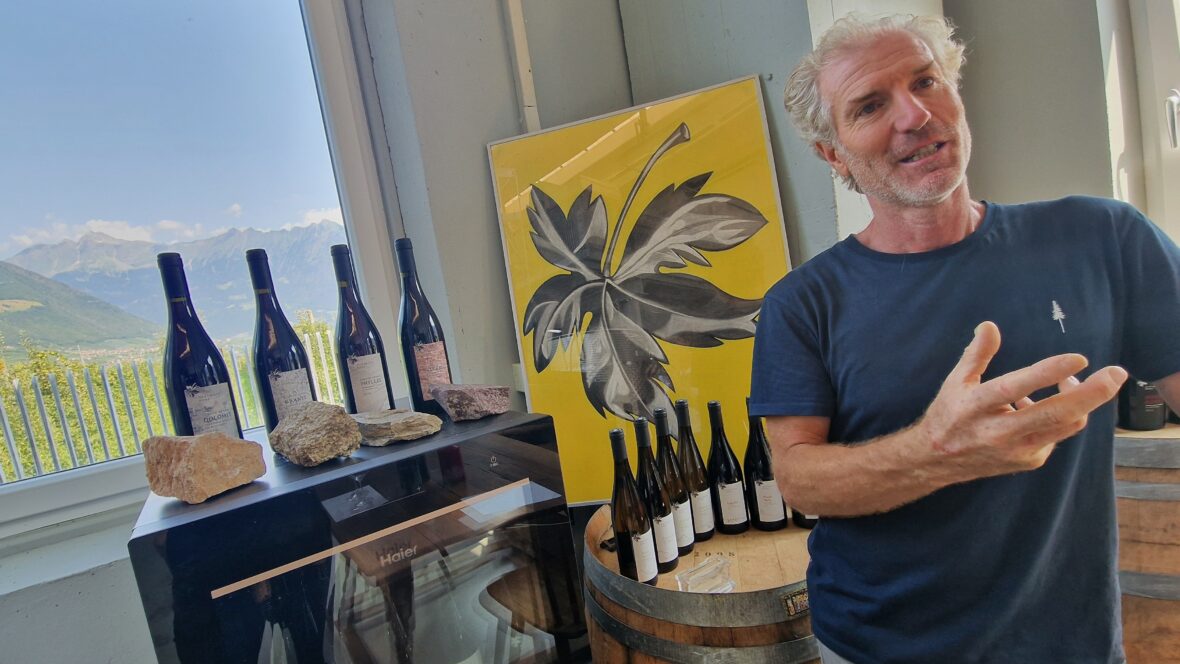
Here they are: “Phyllit” 2022 is a Schiava, towards Val Venosta at 650m with old vineyard on slate, it is essential and coherent, a tasting experience different from many others. While the “Vulkanit” 2022 expresses the structure of the volcanic soil: a Schiava made of ripe fruit and cocoa with firmer tannins. And then the “Granit” 2021, at 500m in Val d’Ultimo smells of wet stone and flowers that announces a slightly more developed profile, with smooth and integrated tannins thanks to the granite, precisely. The Schiava biotype used is the one known as “Schiava Grossa” different from the more common Schiava Gentile (MitterVernatsch).
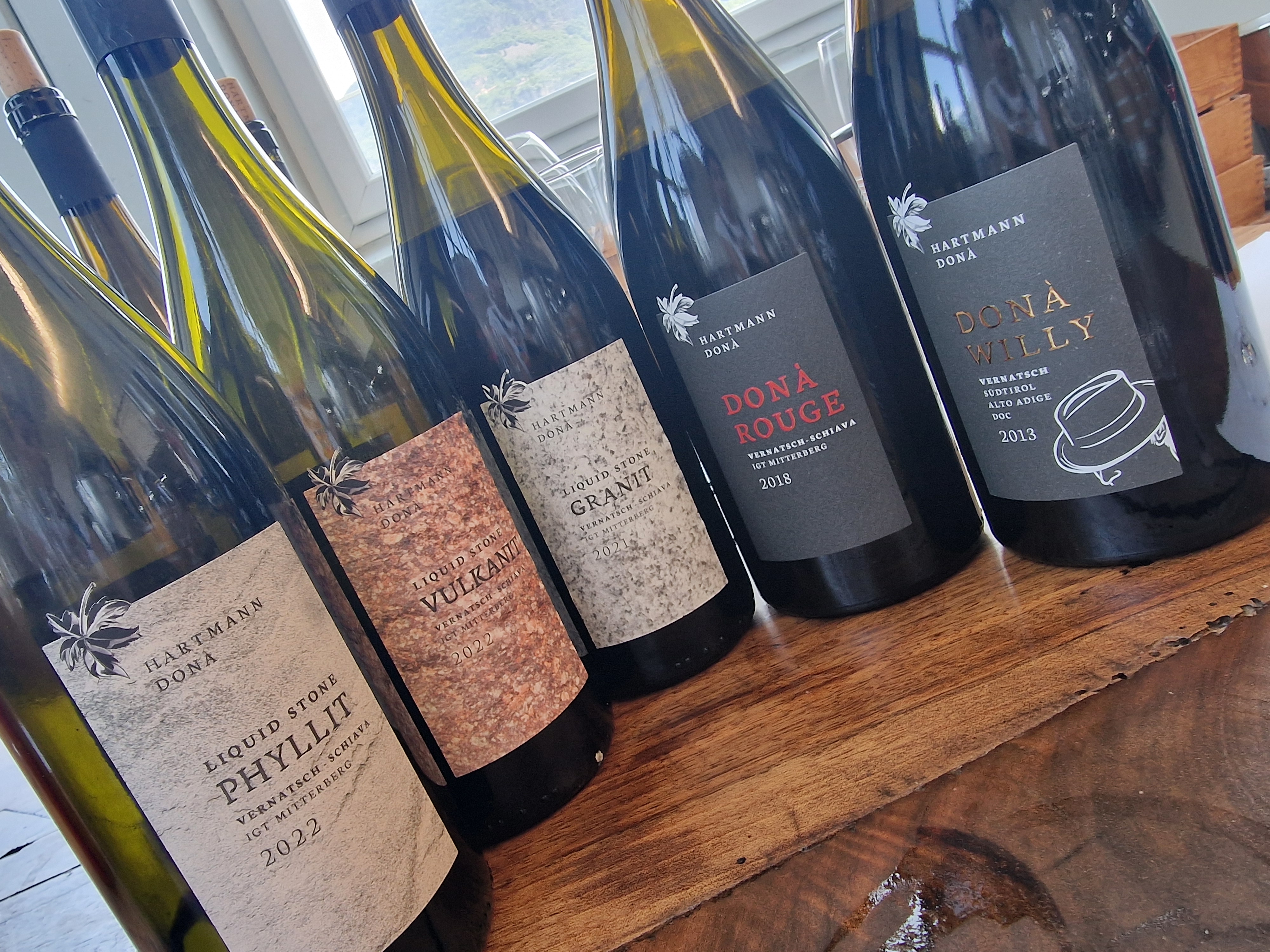
hartmann donà – wine tasting
If we read “Mitter” on the label, the goal is to bottle this prized clone (Mittervernatsch) separately: it ripens earlier and is not suitable for reserves so he works for 30% with whole bunch to enhance its captivating fruit, to be tasted also fresh in the summer for how delicious and dynamic it is.
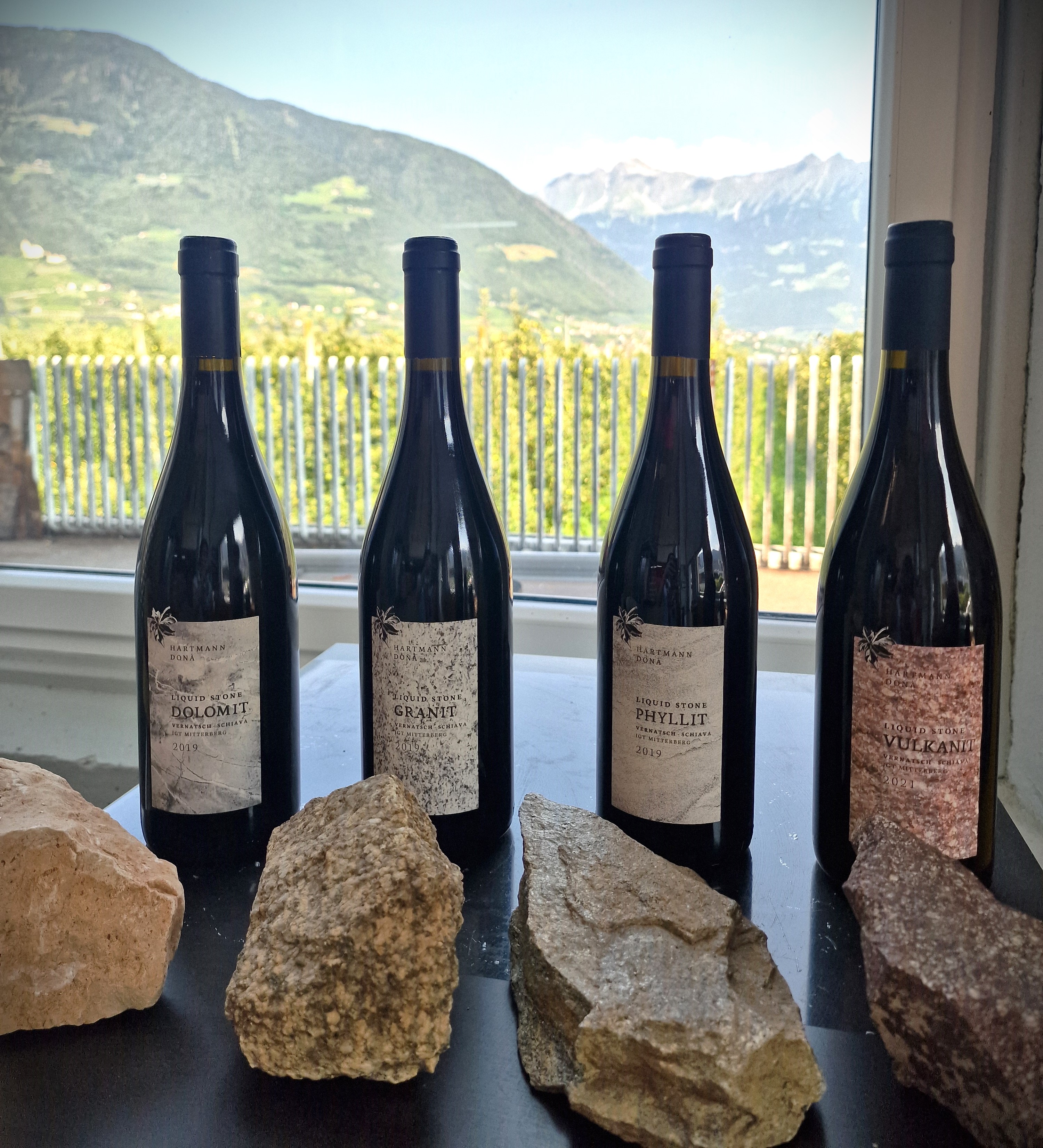
hartmann donà – liquid stone
A gem is the Donà Willy 2013 (another Schiava) that I am truly grateful to have tried: first and only edition because 2013 was a very particular year; cold but sunny in autumn for a more rustic tannin so he chooses to work on it longer: 6 extra months in barrel and then in bottle until he found it ready. It only happens this year and he dedicates it to his father from whom he learned the basics. There is no point in describing the complexity: dairy notes make their way between anise, pepper and black fruits as well as Christmas spices; incredible smoothness in the mouth. Never again a vintage like this, he confesses, perhaps 2023? We’ll see…